
A diagnosis of prostate cancer often brings many questions. While curing the cancer is understandably the top priority, many men are equally concerned about life after surgery—particularly whether they will regain urinary control and preserve sexual function.
Robotic surgery is one of the approaches used to treat prostate cancer. One of the developments is Retzius-sparing robotic-assisted radical prostatectomy (RS-RARP), an alternative surgical technique that aims to support early urinary recovery after prostate cancer surgery.
So, what exactly is Retzius-sparing prostatectomy, and is it the right choice for every patient?
What Is Retzius-Sparing Prostatectomy?
Retzius-sparing prostatectomy is a specialised form of robotic-assisted radical prostatectomy, a minimally invasive operation used to remove the prostate gland in men with localized prostate cancer.
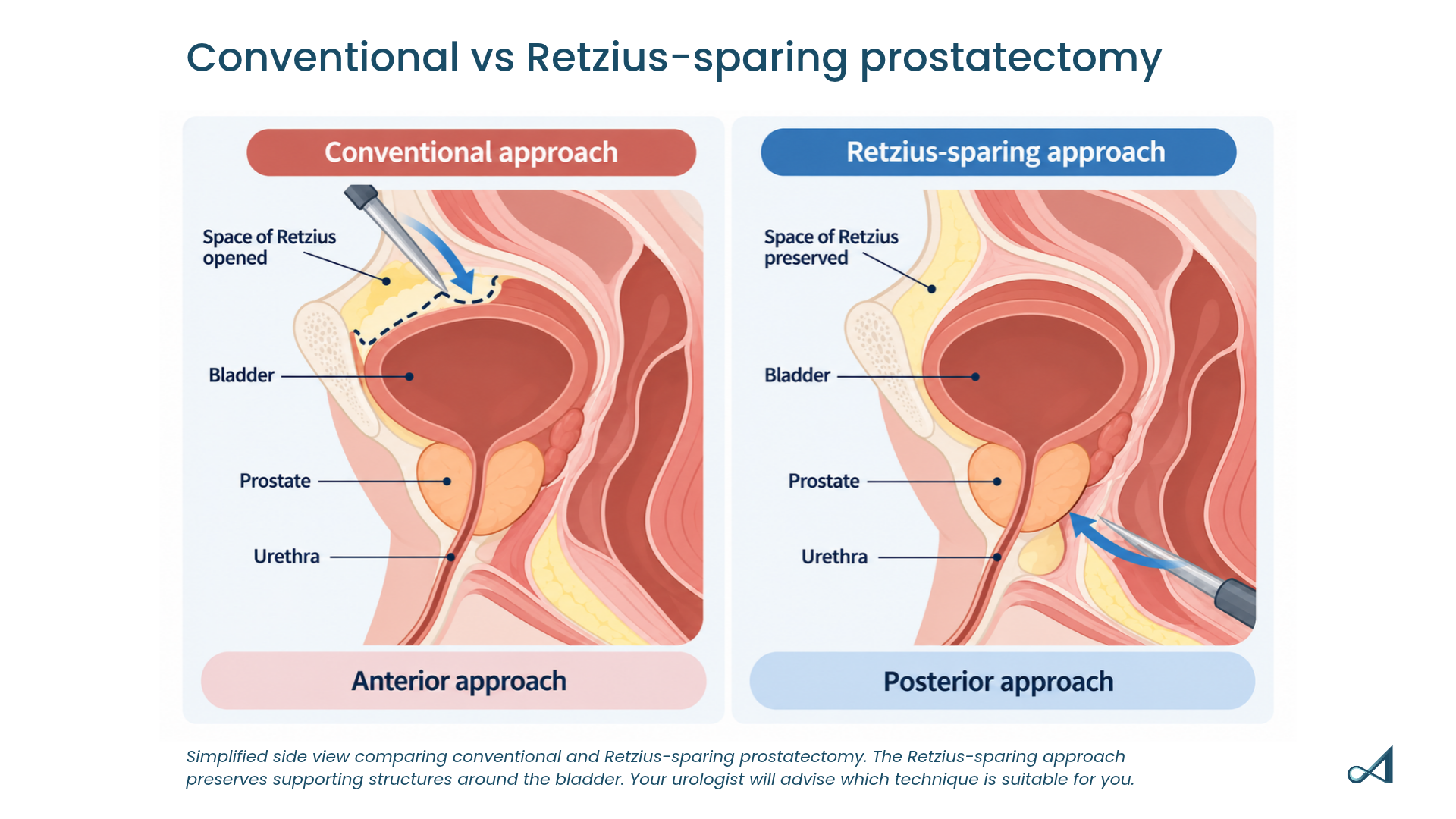
Unlike conventional robotic prostatectomy, which approaches the prostate from above the bladder, the Retzius-sparing technique reaches the prostate from below. This allows the surgeon to preserve an important area called the space of Retzius, along with many of the structures that support the bladder and urinary sphincter.
Although the change in surgical approach may seem small, preserving these structures may affect early recovery for some patients.
Why Is the Retzius-Sparing Technique Different?
The space of Retzius contains several important structures that help support the bladder and maintain urinary continence.
During conventional robotic prostatectomy, these tissues are usually opened or moved aside to reach the prostate. In contrast, the Retzius-sparing approach leaves much of this support system intact.
By preserving the normal anatomy, patients may experience:
- Earlier return of urinary continence
- Preservation of supporting structures around the bladder and urethra
- Less disruption of pelvic tissues
- Potential differences in recovery of erectile function in selected patients
Outcomes depend on several factors, including the patient’s health, the extent of the cancer, and the surgeon’s experience.
Recovery of Urinary Control After Surgery
For many men, urinary leakage after prostate cancer surgery is one of the greatest concerns.
Studies have examined whether Retzius-sparing prostatectomy can support early urinary continence recovery.
Multiple clinical studies have shown that men undergoing the Retzius-sparing technique are more likely to regain urinary control within the first few days, weeks, or months after surgery compared with those undergoing conventional robotic prostatectomy.
Earlier recovery often means:
- Less reliance on urinary pads
- Confidence when returning to work
- Earlier resumption of social and physical activities
- Quality of life during recovery
It is important to note, however, that by one year after surgery, continence outcomes are generally similar between Retzius-sparing and conventional robotic prostatectomy. The main reported difference concerns recovery during the early postoperative period.
How Might Retzius-Sparing Prostatectomy Affect Erectile Function?
Erectile dysfunction remains a recognised risk after any radical prostatectomy because the nerves responsible for erections lie very close to the prostate.
The Retzius-sparing approach follows natural anatomical planes and minimises disturbance of surrounding tissues. This may help preserve the delicate neurovascular bundles when nerve-sparing surgery is possible.
Some studies have reported earlier recovery of erectile function following Retzius-sparing surgery. However, the evidence is currently less consistent than that for urinary continence, and long-term erectile function outcomes appear broadly comparable to conventional robotic prostatectomy.
Recovery of erections depends on many factors, including age, baseline erectile function, underlying medical conditions, cancer location, and whether both nerve bundles can be safely preserved.
How Does Retzius-Sparing Prostatectomy Compare in Cancer Outcomes?
Whenever a newer surgical technique is introduced, the most important question is whether it treats the cancer as effectively as the standard operation.
Research has compared cancer-control outcomes after Retzius-sparing robotic prostatectomy with those after conventional robotic-assisted radical prostatectomy in appropriately selected patients.
Studies have examined outcomes including:
- Positive surgical margin rates
- Pathological findings
- Biochemical recurrence
- Short- and intermediate-term cancer control
For suitable patients, the choice of surgical approach should still prioritise the goal of completely removing the cancer.
Is Everyone Suitable for Retzius-Sparing Prostatectomy?
Not necessarily.
Although Retzius-sparing prostatectomy may offer benefits, it is not suitable for every patient.
Your surgeon will consider several factors before recommending an appropriate surgical approach, including:
- The location and extent of the prostate cancer
- Your prostate size and anatomy
- Previous pelvic surgery
- Whether nerve-sparing surgery is appropriate
- Your baseline urinary function
The choice of surgical technique should prioritise cancer control while considering the preservation of quality of life.
Why Surgeon Experience Matters
Retzius-sparing prostatectomy is technically more demanding than conventional robotic prostatectomy and requires a significant learning curve.
For this reason, the surgeon’s experience often has a greater impact on outcomes than the choice of surgical technique itself.
Patients considering robotic prostate cancer surgery should discuss their surgeon’s experience, complication rates, continence outcomes, and cancer control results during consultation.
The Bottom Line
Retzius-sparing robotic prostatectomy is an alternative approach to prostate cancer surgery. By preserving important pelvic structures involved in urinary continence, this approach may help some patients recover urinary control earlier, while cancer-related outcomes remain an important consideration.
Although it is not suitable for every patient, Retzius-sparing prostatectomy is an option used by surgeons with experience in the technique. If you have been diagnosed with localized prostate cancer, discussing all available surgical approaches with your urologist can help you make an informed decision based on your individual cancer, anatomy, and personal priorities.
Frequently Asked Questions
Is Retzius-sparing prostatectomy different from standard robotic prostatectomy?
Retzius-sparing prostatectomy is associated with faster recovery of urinary continence in many patients. Long-term continence outcomes are generally comparable, while cancer-control considerations should be discussed with the treating surgeon.
Does Retzius-sparing prostatectomy reduce the risk of incontinence?
Current evidence suggests it improves early recovery of urinary continence, although long-term continence rates are similar to conventional robotic prostatectomy.
Can every man with prostate cancer have Retzius-sparing surgery?
No. Suitability depends on factors such as tumour location, cancer stage, prostate anatomy, previous pelvic surgery, and the surgeon’s assessment.
Is Retzius-sparing prostatectomy available everywhere?
Because the procedure is technically more challenging, it is mainly offered by surgeons and centres with extensive experience in robotic prostate cancer surgery.
About Dr Terence Lim Sey Kiat
Dr Terence Lim (林诗杰医生) is a well-experienced Senior Consultant Urologist (泌尿外科高级顾问) in Singapore with a subspecialty in Uro-Oncology with extensive expertise in prostate and kidney cancer surgeries. He is also the Medical Director at Assure Urology & Robotic Centre (安顺泌尿外科中心的医疗总监).
——————————–
This article is for general education and does not replace a proper medical consultation. If you have concerns about your urinary health, kidneys or prostate, an assessment with a urologist can help you better understand your condition and the available treatment options.