

Ambulatory Surgery: The Quick Version
Ambulatory surgery, better known in Singapore as day surgery, means having a planned operation and going home the same day, without an overnight hospital stay. Your specialist first assesses whether the procedure is appropriate for you and whether you can safely return home on the same day, before scheduling it at a day surgery centre. A care team looks after you through recovery, and you continue recovering at home, often with less time away from work and family.
Can You Really Have an Operation and Be Home by Dinner?
Your specialist has just finished explaining what is going on with your knee, and the conversation moves on to the next step. “We can do this as day surgery,” they say, “so you’d be home the same evening.” Then the paperwork arrives with a different phrase on it: ambulatory surgery. You make a mental note to search for it later, and quietly wonder whether it’s doctor-speak for “you’ll be walking out of the operating theatre”. (Not quite, but you’re closer than you think. The two are simply different names for the same thing.)
In Singapore, ambulatory surgery, or day surgery as most people know it, is a routine part of planned surgical care, used across many specialties. It is also worth understanding before you agree to it. In a parliamentary reply on 10 September 2026, the Ministry of Health (MOH) noted that doctors are required to explain the expected benefits and risks of treatments and procedures, including any available alternatives, before consent is taken. Knowing how ambulatory surgery works makes that conversation easier to follow, and much easier to ask questions in.
What Is Ambulatory Surgery?
Ambulatory surgery is what most people in Singapore call day surgery: planned surgery in which you are admitted, have your procedure and are discharged on the same day, without staying overnight in hospital. You may also see it called outpatient surgery, same-day surgery or a day procedure. The word “ambulatory” comes from the Latin for walking: the idea is that you arrive on your own two feet and, once you have recovered enough, leave the same way (usually with a little help from a companion or family member).
Procedures are carried out in a hospital’s day surgery unit or in a licensed day surgery centre, a facility set up specifically for same-day procedures. MOH reported 66 licensed day surgery centres across the public and private sectors as of October 2023, with the number of surgeries and procedures performed at them rising from about 509,000 in 2019 to 565,000 in 2022.
Many procedures that once meant a hospital stay can now be planned this way, often with minimally invasive (keyhole) techniques that use smaller incisions, and anaesthesia chosen to suit a same-day recovery. The Alfa Medicus Group’s ambulatory surgery centres support specialties ranging from orthopaedic, hand and eye surgery to ENT, urology, gynaecology and dental surgery. For examples of procedures in each specialty, see our guide to which procedures can be done as day surgery.
How Is Day Surgery Different From an Inpatient Hospital Stay?
The procedure itself can be similar whichever setting it happens in. What changes is where, and for how long, you are looked after afterwards.
| Ambulatory (day) surgery | Inpatient stay | |
| Going home | The same day, once the team is satisfied with your recovery | After one or more nights, depending on the procedure |
| Where it happens | A day surgery centre or a hospital’s day surgery unit | A hospital ward |
| Often used for | Planned procedures for people whose health is stable | Larger operations, or people who might require closer monitoring |
| Care afterwards | Nurses in a recovery area monitor you until you’re ready to leave | Nursing care on the ward, around the clock |
| Recovery | Mostly at home, with written instructions | Starts in hospital, then continues at home |
| Getting home | A responsible adult accompanies you | Arranged when you’re discharged |
Neither setting is “better” in itself. Your specialist recommends the one that suits your procedure and your health.
For some procedures and some people, a hospital stay with round-the-clock nursing is the more suitable setting. For many planned procedures, though, day surgery brings some real advantages.
What Are the Benefits of Ambulatory Surgery?
When your specialist has checked that a procedure suits same-day discharge, day surgery has several benefits worth knowing about.
Recovering at Home, in Familiar Surroundings
Going home the same day means finishing your recovery with your own bed, your own food and family close by. Victoria’s Department of Health in Australia notes that a familiar environment helps people take an active part in their recovery, and that day surgery encourages moving about early, which can help you get back to everyday activities sooner. With no overnight stay, it can also mean fewer days away from work and fewer caring duties to rearrange.
A Shorter Stay and a Lower Risk of Hospital-Acquired Infections
Spending hours rather than days in a healthcare setting also matters. A World Health Organization policy brief on day surgery notes a lower risk of hospital-acquired infections, and Victoria’s health department lists a reduced risk of hospital-acquired complications among the benefits for well-selected patients. Your specialist will still explain the risks that apply to your own procedure.
Planned Dates That Are Easier to Keep
A day surgery centre handles planned same-day procedures, so your slot doesn’t depend on a ward bed being free. The WHO brief notes that dedicated day surgery facilities see fewer operations taken off the list on the day because of emergencies or bed shortages, which makes it easier to plan your procedure around work and family.
A Compact Workflow, From Theatre to Recovery
Day surgery centres are designed around a single kind of patient journey, so everything sits close together. At the Alfa Medicus centres, the surgical team’s scrub area is a few steps from the operating theatre, and after your procedure you’re wheeled straight to the recovery area just outside, where nurses watch over you as you wake. Short distances and fewer handovers make for a smoother day for you and your specialist’s table.
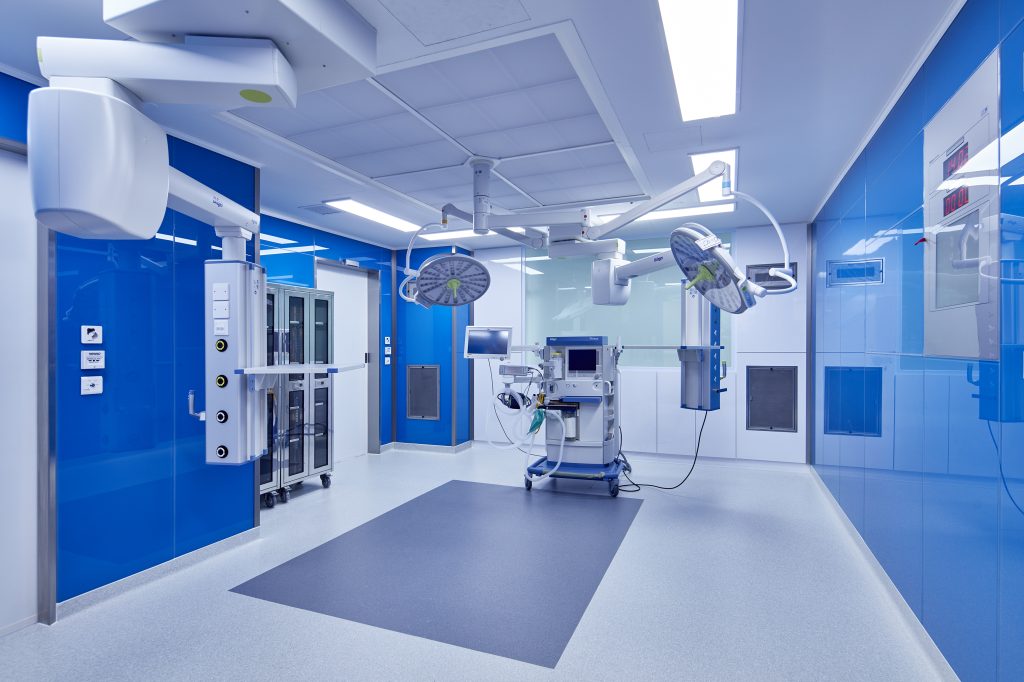
One of the operating theatres at Novaptus Surgery, Camden Medical Centre. At a day surgery centre, the theatre, scrub area and recovery area sit close together.
Private, Comfortable Recovery Suites
Recovery takes place in a quiet, private space. Novena Surgery has five private recovery suites and two recliner chairs, and Novaptus Surgery has private recovery suites alongside recovery beds, so you can rest comfortably until the team is happy for you to go home.
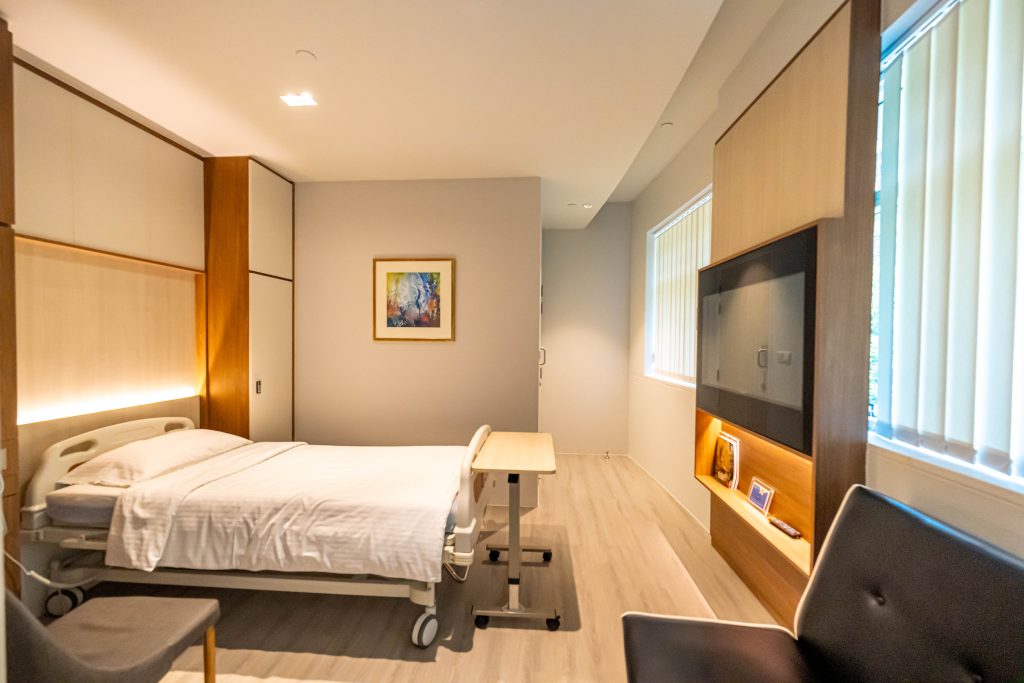
A private recovery suite at Novaptus Surgery, where nurses look after you until you’re ready to go home.
Who Is Ambulatory Surgery Suitable For?
MOH’s position is that procedures can be carried out in an appropriately equipped day surgery centre when a doctor has assessed that the patient does not need a hospital admission for monitoring and care around the operation, and is not at high risk of complications afterwards. To decide, your specialist and anaesthetist will usually look at:
– The type and length of the procedure
– Your general health and any long-term conditions
– Medicines you take, such as blood thinners
– How much pain relief and mobility support you’re likely to need
– Whether someone can take you home and help out afterwards
Age alone does not usually rule this type of surgery out. If same-day discharge isn’t the right fit, your specialist will explain why and suggest a setting which is.
How Does Ambulatory Surgery Work?
Every ambulatory procedure is planned ahead, with much of the preparation happening before the day of the procedure itself. The care pathway usually runs in five steps.
Step 1: Your Specialist Recommends a Procedure
It starts with a consultation. Your specialist examines you, may arrange tests or a scan, for example through OHM Imaging, and explains what they think is going on. If a procedure could help, they will also tell you whether it can be done without an overnight stay. Specialists book theatre time at a day surgery centre for their patients, so you won’t usually need to book the centre yourself.
Step 2: Informed Consent: Understanding Your Options
This is the conversation MOH’s reply describes, and it’s your chance to ask anything at all. Useful questions include:
– What the procedure involves, and why
– Its benefits and risks
– Alternatives, including waiting or non-surgical care
– The type of anaesthesia
– Recovery time and time off work
– Estimated costs, and how they may be paid
Step 3: Getting Ready
You may need a few health checks beforehand, and your care team will give you clear instructions on eating, drinking and medicines. This is also the moment to plan how you’ll get home.
Step 4: The Day Itself
You register at the centre, meet the nurses and your anaesthetist, and have your procedure. Afterwards, nurses look after you in the recovery area until the team is satisfied you’re ready to leave, and you go home with written instructions.
Step 5: Recovering at Home After Outpatient Surgery
SingHealth advises that anyone having day surgery should make sure someone accompanies them home, and should not drive for the next 24 hours. Rest and follow your care instructions. Your follow-up appointment lets your specialist check on your progress and talk through the next steps.
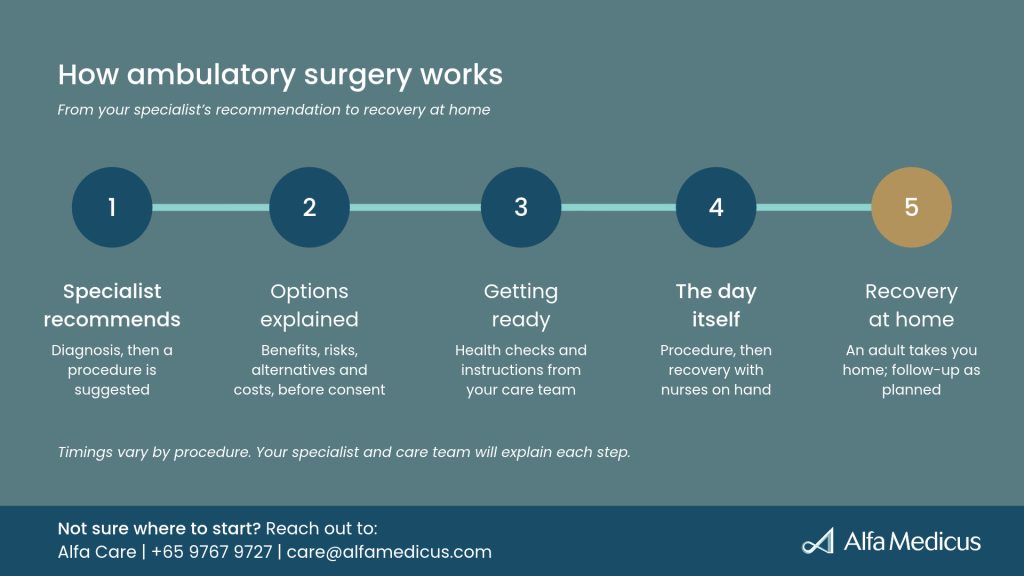
The five steps of ambulatory surgery, from your specialist’s recommendation to recovery at home. Timings vary by procedure.
Do You Need a Referral for Ambulatory Surgery?
Not always. You can see a specialist through a GP referral or, at many private clinics, by booking directly, and your specialist then arranges the procedure. It’s worth booking a consultation if:
– Your GP suggests a specialist opinion
– A problem hasn’t improved after several weeks of non-surgical care
– You’ve been told a procedure may help
– You’d like to understand your options
– Time off work or caring duties are a concern
After any procedure, if you have chest pain, difficulty breathing, heavy bleeding that won’t stop or sudden confusion, call 995 or go to the nearest emergency department. For other concerns, call the number on your discharge instructions.
Not sure where to start? Alfa Medicus’s Alfa Care team can help you find the appropriate specialist within its network: call +65 9767 9727 or email care@alfamedicus.com. You can contact them directly without a referral, and they will advise on next steps.
At the consultation, your specialist, whether your own or one from the group’s specialist clinics, will ask about your symptoms, health and medicines, examine you and explain whether a procedure, and which setting, would suit you.
If ambulatory surgery is recommended, your specialist may perform it at one of the Alfa Medicus Group’s four day surgery centres in Singapore, in Orchard, Novena and the East. Aptus Surgery at Paragon on Orchard Road and Novena Surgery at Novena Medical Centre both have dedicated endoscopy facilities, Aptus Surgery East at i12 Katong has OHM Imaging alongside so scans and surgery can be arranged in one place, and Novaptus Surgery at Camden Medical Centre, off Orchard Boulevard, has a particular focus on eye surgery.
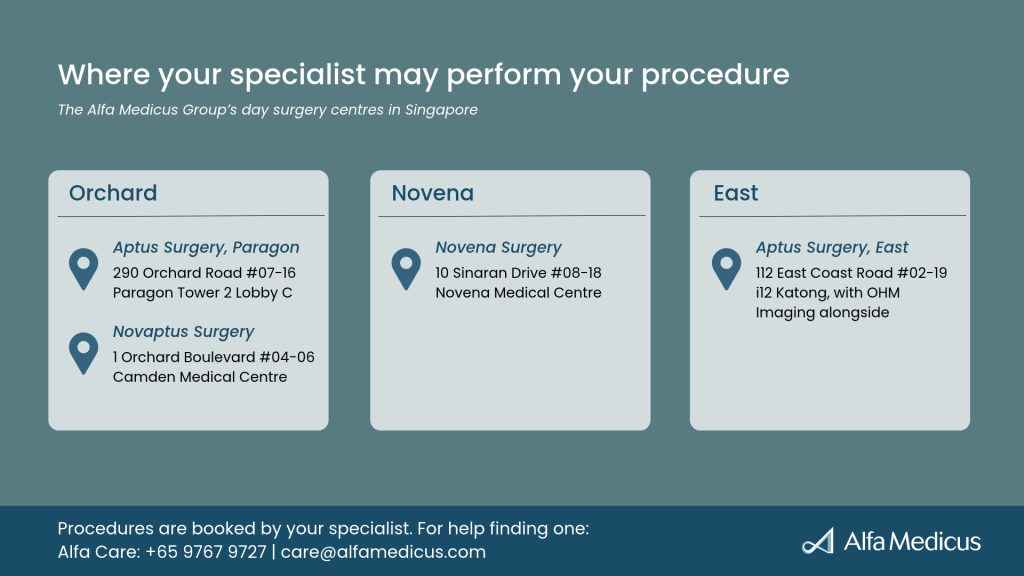
The Alfa Medicus Group’s day surgery centres in Singapore, where your specialist may perform your procedure.
Frequently Asked Questions About Ambulatory Surgery
Is ambulatory surgery the same as outpatient surgery?
Yes. They are different names for the same thing: a planned procedure with same-day discharge. In Singapore, MOH and hospitals usually use the term “day surgery”.
Is a day surgery centre the same as a hospital?
No. A day surgery centre is a licensed facility for planned same-day procedures, without overnight wards.
Who performs the procedure at a day surgery centre?
Your own specialist. Day surgery centres support visiting specialists, who perform the procedure with the centre’s nurses and an anaesthetist where needed.
Will I be put to sleep for outpatient surgery?
Not always. Depending on the procedure, you may have local anaesthesia (numbing a small area), regional anaesthesia (numbing a larger part of the body), sedation, or general anaesthesia. Your anaesthetist will discuss the options with you.
Is outpatient surgery painful?
You may feel some discomfort afterwards, but pain relief is planned with your anaesthetist, and the team checks your pain is under control before you go home.
- Take pain relief as prescribed
- Tell the nurses if pain isn’t settling
- Call the number on your instructions if it gets worse at home
What happens if I need to stay overnight after outpatient surgery?
Your specialist plans the setting in advance, but if you need closer monitoring after the procedure, the care team will arrange the appropriate next step, which may include transfer to a hospital.
Can I choose which surgery centre my procedure is done at?
Often, yes. Specialists usually work at one or more day surgery centres, so ask your specialist which centres they use and whether one is more convenient for you.
Where can I have ambulatory surgery in Singapore?
Your specialist may perform your procedure at one of the Alfa Medicus Group’s day surgery centres in Orchard, Novena and the East (Katong).
- Aptus Surgery Paragon: 290 Orchard Road #07-16, near Orchard and Somerset MRT | +65 6238 8049
- Aptus Surgery East: 112 East Coast Road #02-19, i12 Katong, near Marine Parade MRT | +65 6968 8666
- Novena Surgery: 10 Sinaran Drive #08-18, Novena Medical Centre, near Novena MRT | +65 6254 9331
- Novaptus Surgery: 1 Orchard Boulevard #04-06, Camden Medical Centre, next to Orchard Boulevard MRT | +65 6219 3626
- Help finding a specialist: Patient Care Liaison, +65 8902 2168 or care@alfamedicus.com, or visit the Alfa Medicus website
About the Alfa Medicus Day Surgery Centres
Aptus Surgery (Paragon and i12 Katong), Novena Surgery and Novaptus Surgery are licensed day surgery centres where visiting specialists carry out planned same-day procedures across a range of specialties. Each centre has its own operating theatres, recovery areas and nursing team, who look after patients from registration to discharge. Novena Surgery opened in 2008, Aptus Surgery in 2016 and Novaptus Surgery in 2018, and the Alfa Medicus Group’s Alfa Care team helps patients find an appropriate specialist and coordinate next steps. The centres are part of the Alfa Medicus Group, a healthcare network across Singapore and Malaysia that has been established since 2008.
This article is for general education and does not replace a proper consultation. If you’ve been advised to consider a procedure, a conversation with your specialist is a sensible next step to understand whether ambulatory surgery suits you.
Aptus Surgery | Novena Surgery | Novaptus Surgery | Same-day surgical care, close to home
Aptus Paragon #07-16 | Aptus East i12 #02-19 | Novena Medical Centre #08-18 | Camden Medical #04-06 | Alfa Care Team: +65 9767 9727 | www.alfamedicus.com