

Carpal Tunnel Syndrome in Brief: Symptoms, Causes and Treatment
Carpal tunnel syndrome happens when a nerve in the wrist (the median nerve) gets squeezed as it passes through a narrow channel in the wrist, causing tingling, numbness and sometimes weakness in the thumb and nearby fingers, often at night. Long hours of typing, gaming or scrolling may aggravate symptoms, but age, pregnancy and certain health conditions play a bigger part. Mild cases often settle with a splint and activity changes; persistent symptoms may need surgery to free the nerve.
“Is my phone giving me carpal tunnel?” Carpal tunnel syndrome is what happens when a nerve in the wrist gets squeezed, leaving the fingers tingling or numb, and that question gets searched a lot these days, usually typed one-handed at 1am, mid-scroll, by someone whose fingers have started to feel strangely fuzzy. With year-end deadlines piling up at the desk, and Grand Theft Auto VI arriving with the promise of plenty of late nights on the controller, a lot of hands are about to put in some serious overtime.
Carpal tunnel syndrome is a common cause of tingling and numbness in the hand, and an often misunderstood one. Screens tend to take the blame online, yet the real picture is more nuanced. Knowing what the condition is, what brings it on and which signs deserve a closer look can save you a lot of guesswork, and a lot of anxious late-night searching.
What Is Carpal Tunnel Syndrome?
On the palm side of your wrist is a narrow passageway called the carpal tunnel. Its floor and sides are formed by small wrist bones, and its roof is a tough band of tissue called the transverse carpal ligament. Packed inside are nine tendons that bend your fingers and thumb, plus the median nerve, which carries feeling to the thumb, index, middle and part of the ring finger, and powers some small muscles at the base of the thumb.
Because the tunnel can’t stretch, anything that takes up extra room inside it, such as swelling of the linings around the tendons, can press on the nerve. Carpal tunnel syndrome is the most common of the nerve compression syndromes, conditions where a nerve is pinched somewhere along its path. A nationwide study in South Korea found about 3.6 new diagnoses of carpal tunnel syndrome for every 1,000 people each year, with women diagnosed around two and a half times as often as men, most commonly in their 50s.
What Are the Early Carpal Tunnel Syndrome Symptoms?
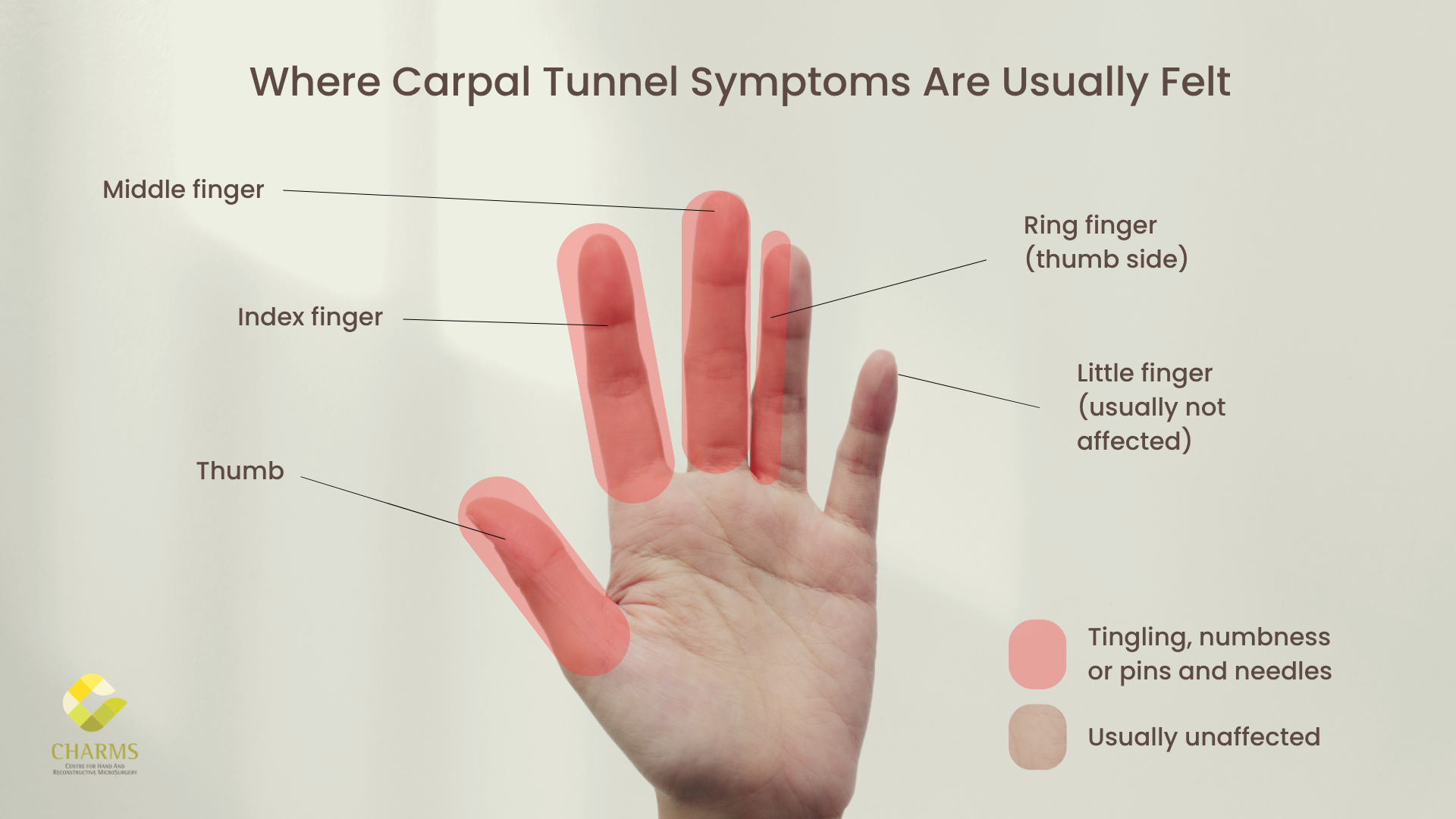
Carpal tunnel syndrome usually affects the thumb, index finger, middle finger and the thumb side of the ring finger; the little finger is usually spared.
Carpal tunnel syndrome symptoms usually creep in gradually rather than arriving with a bang. These are the ones people tend to notice:
- Tingling or numbness in the thumb, index, middle and part of the ring finger
- Waking at night with a numb or “dead” hand
- Tingling while holding a phone, steering wheel, book or controller
- Weakness, clumsiness or dropping objects
Symptoms often come and go at the start, with episodes eventually becoming more frequent or lasting longer. None of these signs on its own confirms carpal tunnel syndrome, as other conditions can cause very similar sensations.
What Actually Causes Carpal Tunnel Syndrome?
Typing, gaming and scrolling can aggravate symptoms, but research hasn’t established them as major causes of carpal tunnel syndrome on their own. Heavy mouse use may be a minor risk factor, while keeping the wrist bent for long periods can increase pressure inside the carpal tunnel.
Other factors tend to play a larger role, including being a woman, getting older, pregnancy, genetics and conditions such as diabetes, an underactive thyroid and rheumatoid arthritis. So if your hand starts tingling after hours at your desk or on a controller, the activity may be triggering the symptoms rather than being the underlying cause.
Is It Carpal Tunnel or Something Else?
These conditions are often mistaken for carpal tunnel syndrome:
| Your Symptoms | Could Point Towards |
|---|---|
| Thumb, index and middle finger tingling | Carpal Tunnel |
| Little and ring finger tingling | Cubital Tunnel |
| Pain on thumb side of wrist when gripping | De Quervain’s |
| Finger catches, clicks or locks | Trigger Finger |
| Neck pain with tingling down the arm | Nerve compression in the neck |
Disclaimer: Symptoms can overlap and proper assessment is needed.
When Should You See a Hand Specialist for Carpal Tunnel Syndrome?
It’s worth having your hand checked if you notice any of the following:
– Tingling or numbness which keeps coming back for more than two to three weeks, even after cutting back on the activities that trigger it
– Regularly waking at night with numb or tingling hands
– Numbness that has become constant rather than coming and going
– Dropping things, or a weak pinch or grip
– New hand tingling during pregnancy, or if you have diabetes or a thyroid condition
If numbness or weakness comes on suddenly, especially with drooping on one side of the face, slurred speech or confusion, call 995 or go to the nearest emergency department, as these can be signs of a stroke rather than a wrist problem.
Not sure if it’s carpal tunnel syndrome? The CHARMS hand care team can help: call +65 6733 9093 or make an appointment online.
At the appointment, a hand specialist will ask about your symptoms, work and hobbies, then examine your hand. This may include gently tapping over the nerve at the wrist, holding the wrist bent to see whether tingling appears, and checking feeling and thumb strength. A history and examination are often enough to make the diagnosis.
X-rays may be arranged if a bone problem is suspected, and nerve conduction studies (tests of how well signals travel along the nerve) may be needed in more severe cases, or when the nerve could be squeezed elsewhere too. The information for new patients explains what to bring.
What Carpal Tunnel Syndrome Treatment Options Are There?
Carpal tunnel syndrome treatment usually steps up gradually, starting simple and moving on if symptoms don’t settle.
Non-Surgical Treatment: Splints, Activity Changes and Therapy
Milder symptoms can often be eased by changing or pacing aggravating activities, wearing a wrist splint at night to keep the wrist straight, and taking anti-inflammatory medication. Nerve vitamins and therapy may also be suggested. A study from the United States, referenced by CHARMS, found non-surgical treatment tends to work better when symptoms are milder and more recent, and is less likely to succeed once tingling is constant or has lasted many months.
Carpal Tunnel Release: When Surgery Is Considered
If symptoms persist or keep returning, or tests show the nerve is being affected, your specialist may suggest a carpal tunnel release procedure. This operation divides the transverse carpal ligament to create more space and take pressure off the nerve. It can be done as an open release through a palm incision, a limited-open release through a smaller incision using a special instrument, or an endoscopic (keyhole) release using a tiny camera. It is commonly carried out as a day procedure.
None of these approaches is “better” than the others in itself. They’re different approaches suited to different hands and situations, and your specialist will explain the benefits, risks and likely recovery of each.
At CHARMS, hand surgeons work alongside in-house hand therapists, so splinting, exercises and rehabilitation are planned together with your surgeon from the start.
What Are the Benefits of Treating Carpal Tunnel Syndrome Early?
Having persistent tingling checked sooner rather than later keeps things simple:
– Simpler treatment first: caught early, many cases are managed with a night splint and activity changes, which SingHealth describes as widely accepted first-line treatment for mild symptoms.
– Looking after your grip: CHARMS notes that an early diagnosis helps protect the nerve and the small thumb muscles it powers.
– Exercises that help: hand therapy can teach exercises that ease pain and improve how the hand works.
At CHARMS, that care is joined up: hand surgeons, the hand therapists mentioned above and nurses work to one plan, from the first assessment through surgery, if needed, to rehabilitation.

What Is Recovery Like After Carpal Tunnel Surgery?
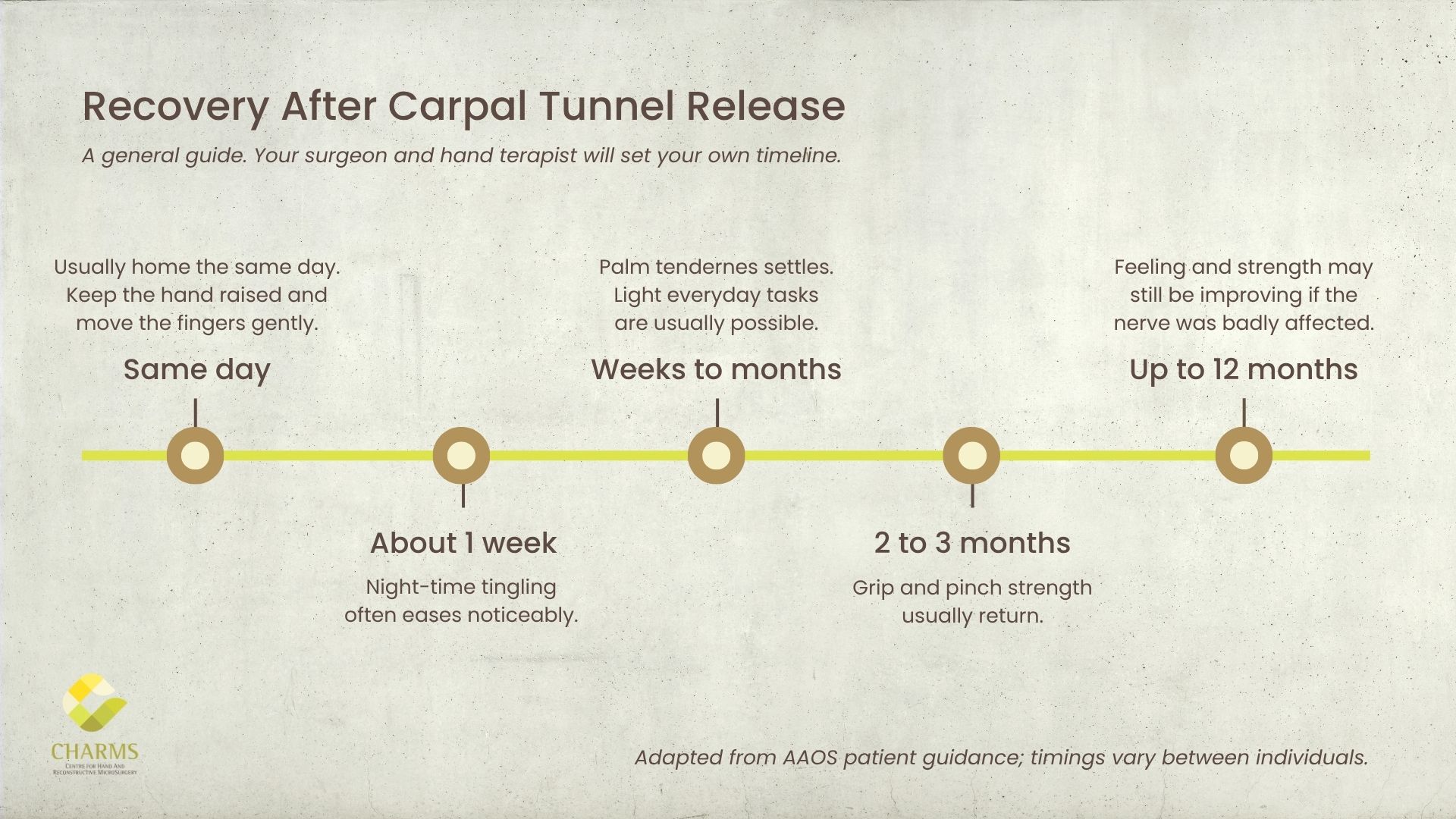
Recovery is usually gradual. Based on guidance from the American Academy of Orthopaedic Surgeons, here’s a general picture:
– You’ll be encouraged to keep your hand raised and move your fingers soon after surgery to limit swelling and stiffness.
– Night-time tingling often improves noticeably within a week or so.
– Tenderness in the palm can linger for several weeks to a few months.
– Grip and pinch strength usually return over about two to three months, and can take longer if the nerve was badly affected.
When the nerve has been compressed for a long time, feeling and strength may take up to a year to improve and may not fully return. Your surgeon will give you post-operative instructions and advise when to return to work, typing or gaming.
Frequently Asked Questions About Carpal Tunnel Syndrome
Can carpal tunnel syndrome go away on its own?
Mild carpal tunnel syndrome can settle, particularly when linked to pregnancy or a temporary change in activity, but symptoms often return if the pressure on the nerve continues. Constant numbness or thumb weakness is less likely to resolve without treatment.
Is gaming bad for carpal tunnel syndrome?
Gaming doesn’t appear to be a major cause of carpal tunnel syndrome, but long sessions with the wrists bent can aggravate symptoms in someone who already has it.
- Take regular breaks and change your grip.
- Keep your wrists closer to straight rather than sharply bent.
- Have persistent tingling during or after play assessed.
Can using my phone cause carpal tunnel syndrome?
There’s no clear evidence that phone use alone causes carpal tunnel syndrome, though holding a phone with a bent wrist for long periods can trigger tingling in a susceptible hand.
Why are carpal tunnel syndrome symptoms worse at night?
Many people sleep with their wrists curled, which raises the pressure inside the carpal tunnel for hours at a time. A night splint that keeps the wrist straight is often one of the simplest ways to ease this.
Which fingers does carpal tunnel syndrome affect?
Carpal tunnel syndrome usually affects the thumb, index finger, middle finger and the thumb side of the ring finger. Tingling mainly in the little finger points more towards the ulnar nerve.
Do exercises help carpal tunnel syndrome?
Exercises alone may not relieve carpal tunnel syndrome, but they can help as part of a wider plan with activity changes and splinting. A hand therapist can teach exercises that help the nerve glide more freely.
Is carpal tunnel surgery done as a day procedure?
Carpal tunnel release is commonly done as a day procedure under local or another form of anaesthesia, so patients usually go home the same day. Your surgeon and anaesthetist will advise which option suits you.
Where can I get carpal tunnel syndrome checked in Singapore?
CHARMS (Centre for Hand and Reconstructive Microsurgery) assesses and treats carpal tunnel syndrome at two clinics in central Singapore, both in the Orchard area.
- CHARMS, Paragon: 290 Orchard Road #09-08, Paragon Medical Suites (Tower 1, Lobby E or F), Singapore 238859. Near Orchard and Somerset MRT. Tel +65 6733 9093.
- CHARMS, Mount Elizabeth: 3 Mount Elizabeth #06-05, Mount Elizabeth Medical Centre, Singapore 228510. A short walk from Orchard MRT. Tel +65 6733 8273.
- Hand surgeons and in-house hand therapists working together from assessment to rehabilitation
- See the CHARMS locations page or make an appointment online.
About CHARMS
CHARMS (Centre for Hand and Reconstructive Microsurgery) cares for hand, wrist and upper limb conditions at clinics in Paragon Medical Suites and Mount Elizabeth Medical Centre.
Established in 2004, its team of hand surgeons, in-house hand therapists and nurses manages issues ranging from overuse problems and sports injuries to fractures and complex reconstructive surgery. Patients are guided every step of the way, from assessment to a clear explanation of surgical and non-surgical options to hand rehabilitation, all under one roof. This holistic approach means the care team works together on each patient’s recovery. CHARMS is part of the Alfa Medicus Group, a healthcare network across Singapore and Malaysia that has been established since 2008.
About Alfa Medicus Group
Alfa Medicus Group runs day surgery centres, diagnostic imaging centres and specialist clinics, including CHARMS, bringing consultation, diagnosis, treatment, surgery and recovery together in one connected network. It entered healthcare in 2008 with Novena Surgery, one of Singapore’s early day surgery centres.
Its Patient Care Liaison team helps patients and families find the appropriate specialist or service within the network, coordinate appointments and plan follow-up, and can be contacted directly without a referral: call +65 8902 2168 or email care@alfamedicus.com.
This article is for general education and does not replace a proper consultation. If tingling or numbness in your hand keeps coming back or is disturbing your sleep or grip, an assessment with a hand specialist is a sensible next step to understand your options.