

Being diagnosed with a kidney tumour can be frightening, and one of the first questions many patients ask is, “Will my entire kidney need to be removed?”
Advances in surgical techniques mean that the answer is sometimes no.
For many patients with small or appropriately located kidney tumours, surgeons can remove only the tumour while preserving the healthy part of the kidney. This procedure is known as a partial nephrectomy or kidney-sparing surgery. Today, many of these operations are performed using robot-assisted partial nephrectomy (RAPN), a minimally invasive technique that combines robotic technology with the principles of organ preservation.
So, what is the difference between a partial nephrectomy and a radical nephrectomy? What are the benefits of preserving the kidney? And how does robot-assisted surgery compare with laparoscopic and traditional open surgery?
What Is a Partial Nephrectomy?
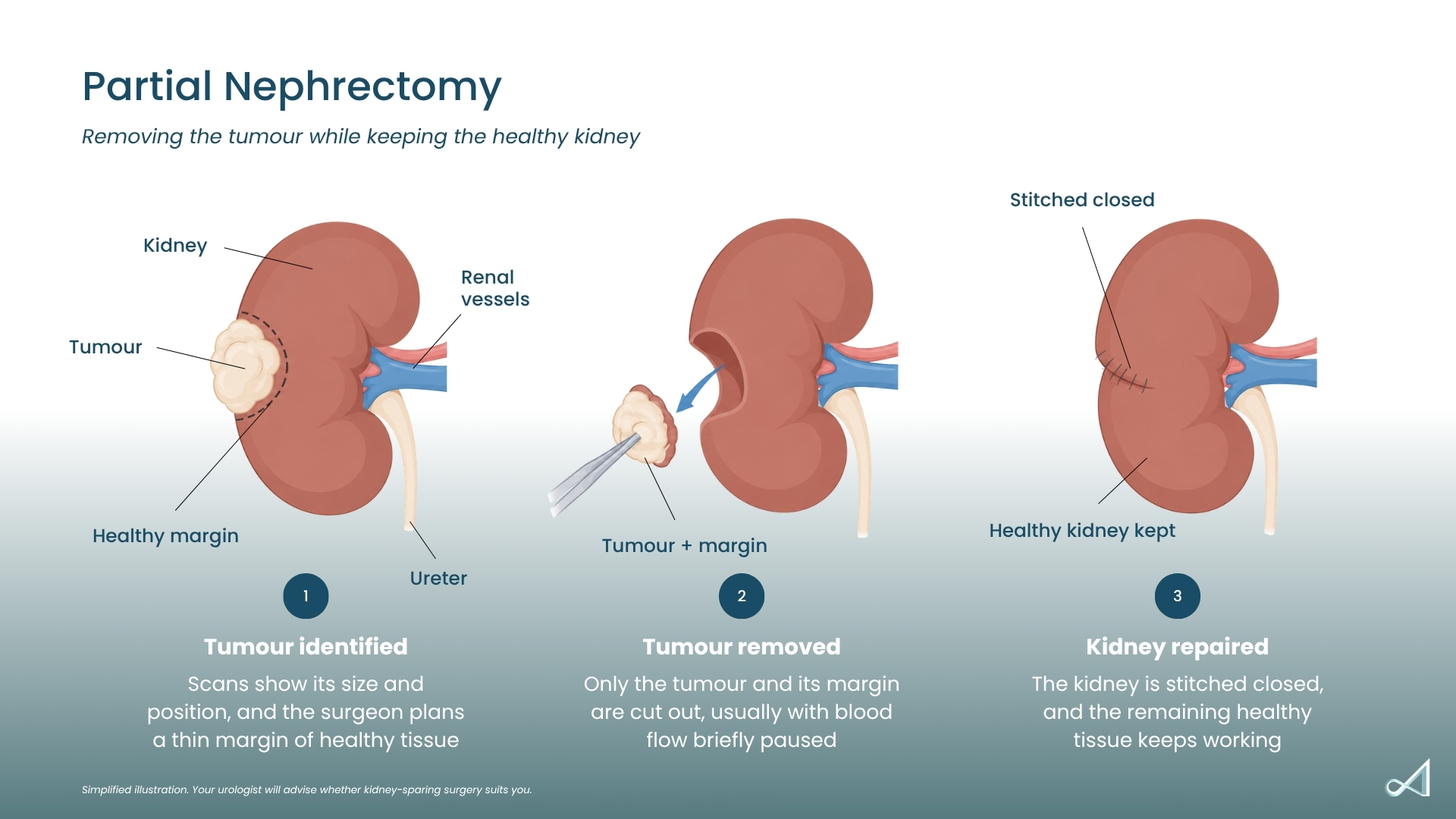
A partial nephrectomy is an operation in which the surgeon removes the kidney tumour together with a small rim of normal tissue, while leaving the rest of the kidney intact.
The goal is to completely remove the cancer while preserving as much healthy kidney tissue as possible.
Partial nephrectomy is commonly recommended for many patients with small kidney cancers (typically less than 4 cm) and is increasingly performed for selected larger or more complex tumours when technically feasible.
Preserving kidney function has become an important part of modern kidney cancer treatment because many patients can enjoy cancer control without sacrificing an entire kidney.
What Is a Radical Nephrectomy?
A radical nephrectomy involves removing the entire kidney together with the surrounding fatty tissue. In certain cases, the adrenal gland or nearby lymph nodes may also need to be removed.
Radical nephrectomy remains an important operation and may be recommended when:
- The tumour is very large
- The cancer occupies most of the kidney
- Multiple tumours are present
- The tumour involves major blood vessels
- Partial nephrectomy cannot be performed safely
Although most people can live well with one healthy kidney, preserving kidney function whenever possible is often an important consideration.
Why Is Preserving the Kidney Important?
Our kidneys play a vital role in filtering waste products, regulating blood pressure, maintaining electrolyte balance, and supporting overall health.
Removing an entire kidney reduces the body’s total kidney function. While many patients continue to live normal lives with one kidney, preserving healthy kidney tissue may reduce the long-term risk of chronic kidney disease, particularly in patients who already have:
- Diabetes
- High blood pressure
- Chronic kidney disease
- Kidney stones
- Reduced kidney function
- A solitary kidney
- Multiple kidney tumours
For this reason, modern urological guidelines recommend kidney-sparing surgery whenever it is oncologically safe and technically feasible.
What Are the Benefits of Partial Nephrectomy?
Compared with radical nephrectomy, partial nephrectomy has several potential benefits.
Preservation of Kidney Function
One benefit is preserving healthy kidney tissue.
Maintaining more functioning kidney tissue helps reduce the decline in kidney function after surgery and may lower the long-term risk of chronic kidney disease.
Cancer Control
Many patients worry that removing only part of the kidney may increase the risk of cancer recurrence.
Studies have shown that for appropriately selected small kidney cancers, partial nephrectomy provides cancer control comparable to radical nephrectomy, while preserving more kidney function.
Reduced Risk of Future Kidney Problems
Patients who retain more kidney tissue are generally less likely to develop chronic kidney disease over time.
This is especially important for younger patients and those with medical conditions affecting kidney health.
Are There Any Disadvantages to Partial Nephrectomy?
Although partial nephrectomy has potential benefits, it is technically more challenging than removing the entire kidney.
Compared with radical nephrectomy, the operation may carry a slightly higher risk of:
- Bleeding
- Urine leakage from the collecting system
- Longer operating time
- Temporary reduction in kidney blood flow during tumour removal
These complications can occur, and their likelihood depends on factors including tumour complexity and surgical experience. Robotic instruments may assist surgeons with some technical challenges.
What Is Robot-Assisted Partial Nephrectomy?
Robot-assisted partial nephrectomy (RAPN) is a minimally invasive operation performed through several small abdominal incisions using a robotic surgical system.
Despite the name, the robot does not perform the operation independently. Every movement is controlled entirely by the surgeon.
The robotic platform provides:
- High-definition three-dimensional magnified vision
- Wristed instruments with articulated movement
- Tremor filtration
- Instrument control during delicate tumour removal and kidney reconstruction
These features are relevant because partial nephrectomy requires precise tumour excision followed by careful reconstruction of the remaining kidney.
Robot-Assisted vs Open Partial Nephrectomy
Open partial nephrectomy has been performed successfully for many decades and remains an option in selected complex cases.
However, compared with open surgery, robot-assisted partial nephrectomy generally offers:
- Smaller incisions
- Less postoperative pain
- Reduced blood loss
- Lower transfusion rates
- Shorter hospital stay
- Faster recovery
- Earlier return to work and normal activities
Importantly, long-term cancer outcomes are comparable when performed by experienced surgeons.
Because the scaphoid has a limited blood supply, a fracture that goes unnoticed can be slow to heal. That’s not a reason to worry after every tumble, but it is a good reason not to try to play through thumb-side pain after a fall and get the injury thoroughly checked before returning to the court.
Robot-Assisted vs Laparoscopic Partial Nephrectomy
Both laparoscopic and robotic surgery are minimally invasive techniques, but robotic technology has several technical differences.
Conventional laparoscopy relies on long, rigid instruments and two-dimensional vision, making tumour excision and kidney reconstruction technically demanding.
By contrast, robotic surgery provides:
- Three-dimensional high-definition vision
- Articulated instrument movement
- Instrument control
- Console-based ergonomics for the surgeon
- Instruments that can assist with intracorporeal suturing during kidney reconstruction
These features may be useful during reconstruction after tumour removal, where precise suturing helps minimise bleeding and urine leakage while reducing the duration of warm ischaemia (time when the blood supply to the kidney is cut). A long warm ischemia time is associated with short and long term kidney impairment.
As a result, robot-assisted partial nephrectomy is used as a minimally invasive approach in many high-volume centres worldwide.
What Is Warm Ischaemia Time?
During most partial nephrectomies, the blood supply to the kidney is temporarily clamped to minimise bleeding while the tumour is removed.
This period is known as the warm ischaemia time.
Keeping this time as short as possible helps preserve kidney function.
The articulated instruments and magnified vision used in robotic surgery may facilitate faster tumour excision and kidney reconstruction, potentially contributing to shorter warm ischaemia times in appropriately selected cases.
How Do Cancer Outcomes Compare Between Surgical Approaches?
The primary goal of surgery is always complete cancer removal.
Current evidence shows that robot-assisted, laparoscopic, and open partial nephrectomy all provide cancer control when performed by experienced surgeons.
The main differences associated with robotic surgery relate to recovery and technical features rather than higher cancer cure rates.
The success of surgery depends far more on careful surgical planning, complete tumour removal, and surgeon experience and expertise than on the surgical platform itself.
Does Surgeon Experience Matter?
Absolutely.
Partial nephrectomy is a technically demanding operation in urology.
Choosing between partial nephrectomy and radical nephrectomy—and deciding whether a minimally invasive approach is appropriate—requires careful assessment of the tumour, kidney anatomy, and patient factors.
Numerous studies have shown that surgeon experience and expertise have a major influence on complication rates, kidney preservation, and long-term outcomes.
When discussing surgery, patients should feel comfortable asking about their surgeon’s experience, complication rates, and experience with robot-assisted kidney surgery.
The Bottom Line
Robot-assisted partial nephrectomy is used to treat some kidney tumours by allowing surgeons to remove the cancer while preserving healthy kidney tissue. Compared with radical nephrectomy, kidney-sparing surgery helps maintain kidney function while aiming to maintain cancer control in appropriately selected patients. Compared with traditional open surgery, the robotic approach offers the benefits of minimally invasive surgery, including smaller incisions, less pain, reduced blood loss, and faster recovery. Compared with conventional laparoscopic surgery, robotic technology provides three-dimensional vision and articulated instruments, which can assist with technically demanding parts of the operation.
Not every patient is suitable for a partial nephrectomy, and not every tumour can be safely removed while preserving the kidney. The choice of treatment depends on the size and location of the tumour, overall kidney function, and the expertise of the surgeon. An experienced urologist can help determine the most appropriate approach to achieve a balance between curing the cancer and preserving long-term kidney health.
Frequently Asked Questions
How Does Partial Nephrectomy Compare with Radical Nephrectomy?
For many patients with small, localized kidney cancers, partial nephrectomy is often recommended because it preserves kidney function while providing cancer control comparable to radical nephrectomy.
How Does Robot-Assisted Partial Nephrectomy Compare with Open Surgery?
Robot-assisted surgery is associated with less blood loss, smaller incisions, less postoperative pain, and a faster recovery. Both approaches carry risks and may be appropriate depending on individual circumstances.
Does removing only part of the kidney increase the risk of cancer recurrence?
For appropriately selected kidney tumours, partial nephrectomy provides cancer outcomes comparable to radical nephrectomy while preserving more healthy kidney tissue.
How long does recovery take after robot-assisted partial nephrectomy?
Most patients stay in hospital for two to three days and can gradually return to normal daily activities over the following few weeks, although recovery varies depending on the individual and the complexity of the surgery.
About Dr Terence Lim Sey Kiat
Dr Terence Lim (林诗杰医生) is a well-experienced Senior Consultant Urologist (泌尿外科高级顾问) in Singapore with a subspecialty in Uro-Oncology with extensive expertise in prostate and kidney cancer surgeries. He is also the Medical Director at Assure Urology & Robotic Centre (安顺泌尿外科中心的医疗总监).
This article is for general education and does not replace a proper consultation. If you have concerns about your urological health, an assessment with a urologist is the best next step to understand your options.