
A diagnosis of prostate cancer can be overwhelming, and one of the first questions many men ask is, “How do the different types of prostate surgery compare?”
Today, patients may be offered several surgical options to remove the prostate gland, including open radical prostatectomy, laparoscopic radical prostatectomy, and robot-assisted radical prostatectomy (RARP). While all three procedures aim to cure localized prostate cancer by completely removing the prostate gland, they differ in how the surgery is performed and what patients can expect during recovery.
Understanding these differences can help you have a more informed discussion with your urologist and choose the treatment that suits your individual needs.
What Is a Radical Prostatectomy?
A radical prostatectomy is an operation to remove the entire prostate gland and seminal vesicles to treat localized prostate cancer. Depending on the cancer stage, nearby pelvic lymph nodes may also be removed.
The primary goal of surgery is to completely remove the cancer while preserving urinary continence and erectile function whenever it is safe to do so.
Today, radical prostatectomy can be performed using three main approaches:
- Open radical prostatectomy
- Laparoscopic radical prostatectomy
- Robot-assisted radical prostatectomy (RARP)
Although the objective is the same, each technique differs in surgical access, technology, and recovery.
Open Radical Prostatectomy
Open radical prostatectomy is the traditional method that has been performed for several decades.
The surgeon makes a single incision in the lower abdomen to access and remove the prostate directly.
Open surgery remains an effective treatment with long-term cancer control, particularly when performed by experienced surgeons. However, because it requires a larger incision, recovery is generally longer than with minimally invasive techniques.
Patients undergoing open surgery may experience:
- More postoperative pain
- Greater blood loss
- Higher likelihood of requiring blood transfusion
- Longer hospital stay
- Larger surgical scar
- Longer recovery before returning to normal activities
Despite these differences, cancer control and long-term functional outcomes can still be achieved in experienced hands.
Laparoscopic Radical Prostatectomy
Laparoscopic radical prostatectomy was developed as a minimally invasive alternative to open surgery.
Instead of one large incision, several small incisions are used to insert a camera and long surgical instruments into the abdomen.
Compared with open surgery, laparoscopic prostatectomy generally offers:
- Smaller scars
- Less blood loss
- Reduced postoperative pain
- Shorter hospital stay
- Faster recovery
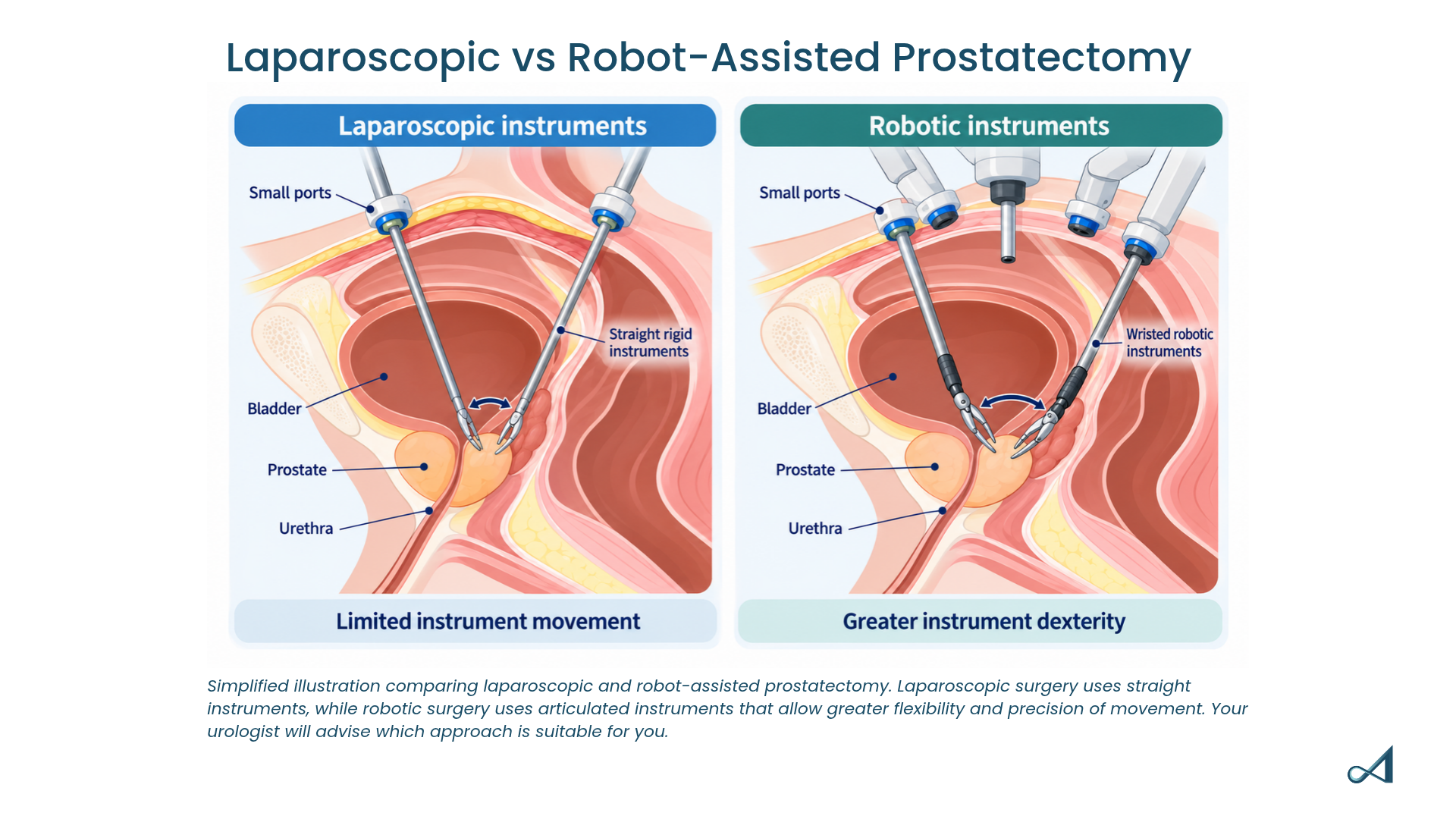
However, laparoscopic surgery has technical limitations. The surgeon operates using rigid instruments with limited degrees of movement while viewing a two-dimensional monitor, making delicate reconstruction and nerve-sparing more technically demanding.
For this reason, laparoscopic radical prostatectomy has become less common in many countries where robotic technology is available.
Robot-Assisted Radical Prostatectomy (RARP)
Robot-assisted radical prostatectomy is a commonly performed surgical approach for localized prostate cancer in many high-volume centres worldwide.
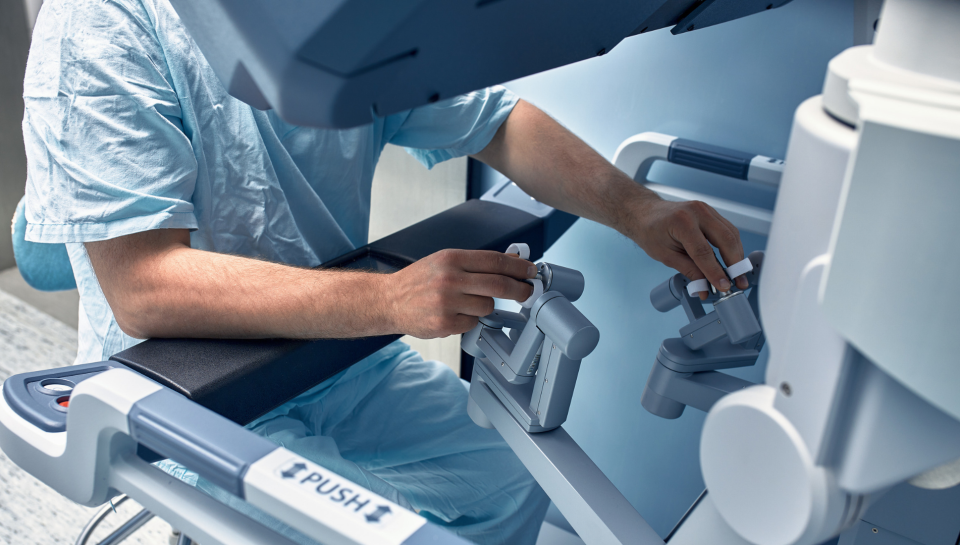
Despite its name, the operation is not performed by a robot independently. Every movement of the robotic instruments is fully controlled by the surgeon, who sits at a nearby console.
The robotic system translates the surgeon’s hand movements into scaled instrument movements while filtering out natural hand tremor.
Features of robotic surgery include:
- High-definition three-dimensional magnified vision
- Wristed instruments that mimic the movement of the human hand
- Instrument control within the narrow confines of the pelvis
- Ergonomic positioning for the surgeon
- Instruments that assist with delicate nerve-sparing and reconstructive surgery
These technological features are among the reasons robotic surgery is used in many specialist centres.
How Does Robotic Prostate Surgery Compare with Open Surgery?
Numerous studies have compared robot-assisted radical prostatectomy with open radical prostatectomy.
Compared with open surgery, robotic prostatectomy is associated with:
- Less blood loss
- Lower transfusion rates
- Smaller incisions
- Reduced postoperative pain
- Shorter hospital stay
- Faster recovery
- Earlier return to normal daily activities
Many patients are able to return home within two or three days after robotic surgery, depending on their recovery and overall health.
Importantly, cancer control remains comparable between robotic and open surgery when performed by experienced surgeons.
How Does Robotic Surgery Compare with Laparoscopic Surgery?
Both laparoscopic and robotic prostatectomy are minimally invasive procedures, but robotic technology offers several technical advantages.
The robotic platform provides three-dimensional vision, magnified visualisation, and instruments with a greater range of motion than conventional laparoscopic instruments.
These features may facilitate:
- Controlled dissection
- Nerve-sparing techniques
- Bladder-to-urethra reconstruction
- An ergonomic operating position
- Reduced surgeon fatigue during lengthy operations
Although both techniques achieve cancer control, robotic surgery has become a minimally invasive approach used in many hospitals because it addresses some technical limitations of conventional laparoscopy.
What About Urinary Continence and Erectile Function?
Two of the biggest concerns after prostate cancer surgery are urinary leakage and erectile dysfunction.
Recovery of urinary continence and sexual function depends on several factors, including:
- Patient age
- Baseline urinary function
- Baseline erectile function
- Cancer location
- Whether nerve-sparing surgery is possible
- Overall health
- Surgeon experience
Current evidence suggests that robotic surgery may facilitate earlier recovery of urinary continence compared with open surgery, although long-term continence rates become similar in many studies.
Likewise, robotic technology may assist with nerve-sparing surgery, but preservation of erectile function ultimately depends on patient factors and the ability to safely preserve the neurovascular bundles without compromising cancer control.
How Does Robotic Surgery Compare in Cancer Control?
One common misconception is that robotic surgery is associated with higher prostate cancer cure rates simply because it uses advanced technology.
In reality, the robot is a surgical tool—not a guarantee of higher cancer cure rates.
Current evidence shows that open, laparoscopic, and robot-assisted radical prostatectomy all provide cancer control when performed by surgeons experienced in their respective techniques using sound oncological principles.
The success of prostate cancer surgery depends far more on:
- Appropriate patient selection
- Careful surgical planning
- The surgeon’s experience and training
- Adherence to cancer surgery principles
The goal is complete removal of the cancer while preserving urinary and sexual function whenever it is safe to do so.
Does Surgeon Experience Matter More Than the Surgical Approach?
Absolutely.
Many studies have shown that surgeon experience and surgical volume have a greater influence on outcomes than the choice between open, laparoscopic, or robotic surgery.
An experienced surgeon is more likely to achieve:
- Lower complication rates
- Cancer control
- Urinary continence recovery
- Preservation of erectile function
- Lower positive surgical margin rates
When choosing where to undergo prostate cancer surgery, it is reasonable to ask your urologist about their training, experience, surgical volume, continence outcomes, complication rates, and cancer control results.
Which Patients Are Suitable for Robot-Assisted Radical Prostatectomy?
Most men with localized prostate cancer who are suitable candidates for surgery can also be considered for robot-assisted radical prostatectomy.
However, the choice of surgical approach should be individualised based on factors such as:
- Cancer stage and location
- Prostate size
- Previous abdominal or pelvic surgery
- Overall health
- Patient preferences
- Surgeon expertise
- Availability of robotic technology
Your urologist will recommend the most appropriate option after considering all of these factors.
The Bottom Line
Robot-assisted radical prostatectomy is an approach to the surgical treatment of localized prostate cancer by combining minimally invasive surgery with robotic technology. Compared with open surgery, it offers less blood loss, smaller incisions, reduced postoperative pain, and a faster recovery while maintaining cancer control. Compared with conventional laparoscopic surgery, robotic technology provides magnified visualisation and instruments with greater dexterity, which can assist during complex prostate surgery.
However, no single surgical approach is suitable for every patient. Important factors remain appropriate patient selection, careful surgical planning, and the experience of the operating surgeon. If you have been diagnosed with prostate cancer, discussing all available treatment options with an experienced urologist will help you choose the approach that offers an appropriate balance between cancer control, recovery, and long-term quality of life.
Frequently Asked Questions
How does robotic prostate surgery compare with open surgery?
Robotic prostate surgery generally results in less blood loss, less pain, a shorter hospital stay, and faster recovery than open surgery. Long-term cancer control is comparable when performed by experienced surgeons.
How does robotic prostatectomy compare with laparoscopic prostatectomy?
Both are minimally invasive techniques, but robotic surgery offers three-dimensional vision and greater instrument dexterity, which may assist the surgeon during delicate prostate surgery.
Is robot-assisted radical prostatectomy safe?
Robot-assisted radical prostatectomy is a well-established procedure that has been performed worldwide for more than two decades and is a treatment option for appropriately selected men with localized prostate cancer. Like other surgical procedures, it carries risks.
Does the robot perform the operation by itself?
No. The robotic system does not operate independently. Every movement is performed by the surgeon, who controls the robotic instruments throughout the procedure.
About Dr Terence Lim Sey Kiat
Dr Terence Lim (林诗杰医生) is a well-experienced Senior Consultant Urologist (泌尿外科高级顾问) in Singapore with a subspecialty in Uro-Oncology with extensive expertise in prostate and kidney cancer surgeries. He is also the Medical Director at Assure Urology & Robotic Centre (安顺泌尿外科中心的医疗总监).
——————————–
This article is for general education and does not replace a proper medical consultation. If you have concerns about your urinary health, kidneys or prostate, an assessment with a urologist can help you better understand your condition and the available treatment options.