
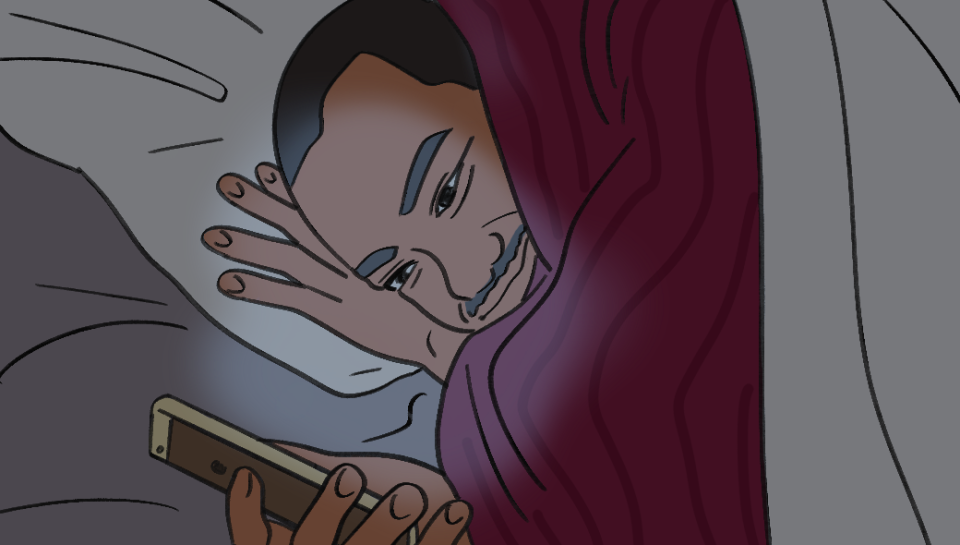
Before you assume it’s carpal tunnel, depending on which part of your hand goes numb can make it more or less likely.
It’s the end of the day, I’m in bed. One more TikTok, one more reel… then part of my hand goes numb. I shake it out and change position, and it improves.
Now I’m Googling “do i have carpal tunnel?”
But before jumping to that, there’s a more useful question: which part of my hand actually went numb?
The nerve map
If you think about your nerves like a subway network, there are three major lines, the median, ulnar and radial nerves. These nerves travel down your arm and branch out towards different parts of your hand which serve their own set of ‘stations’ which is why pressure on one nerve can make certain areas go numb but leave the rest completely normal.
Brief numbness that disappears when you change position is different from keeping a nerve under repeated or prolonged pressure. When compression becomes persistent, it can irritate the nerve and interfere with the signals travelling along it.
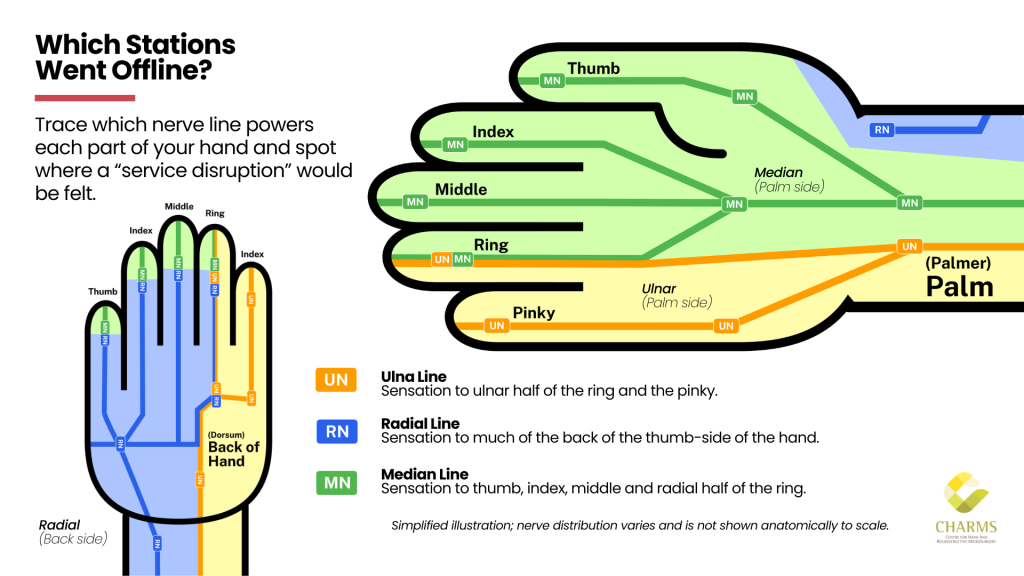
Which stations went offline?
Before you change position, take a second to notice which parts of your hand are numb or tingling. Whether the sensation is on the palm or back of the hand, how your wrists and elbows are positioned, and how you’re lying. This gives us a clue where the pressure may be coming from.
If it’s your pinky and half your ring finger…
This points towards your ulnar nerve, which runs along the inside of your arm and passes behind the bony part of your elbow. This is better known as your ‘funny bone’ — the same area that causes that uncomfortable jolt of electricity when you knock it against something.
If you were lying with your elbow tightly bent, with your arm beneath you or resting the inside of your elbow against the mattress, it could cause the pressure.
If it’s your thumb, index, middle and part of your ring finger on the palm side…
That pattern points more towards your median nerve, which travels through the wrist via the carpal tunnel. Holding your phone with your wrist curled for an extended period may increase pressure within the carpal tunnel.
Important to note however, if the numbness was mainly over the back of the hand near the thumb, then it may be the superficial radial nerve.
If it’s one finger…
Each finger has smaller digital nerves running along its sides that branch from the major nerve lines, like leaving the subway and taking a local route to your stop.
Direct pressure on one of these smaller nerves can therefore produce a much more localized patch of numbness, sometimes involving just one finger or one side of the finger.
If it’s the whole hand…
If the whole hand feels numb, the pattern is less specific. Several nerves may be affected at once, or the problem may be occurring further up the arm. Position, whether one or both hands are involved, and what happens after you move become especially useful clues.
Lying on your whole arm, trapping it under your body or holding your shoulder and arm in an awkward position for a long time can produce a pattern like this.
How to doomscroll
There isn’t a perfect doomscroll position that balances practicality with comfort (given that most people don’t doomscroll with perfect posture), but it’s best to avoid keeping one nerve under pressure for a long time.
Dr Lim Beng Hai’s preferred solution is surprisingly simple: don’t make your hand hold the phone in the first place
“The best is to have a phone stand beside your face when you’re lying down. This eliminates the strain from your hand altogether.”
Suddenly, those advertisements I see on my feed, where people scroll with a Bluetooth remote don’t seem so silly.
But if you don’t want to buy a phone stand, there are alternative positions you can consider.
If you’re lying on your back, try to keep your wrists relatively straight rather than bending them towards your forearms and avoid holding your elbows bent tightly against your body for long periods of time. A pillow or supportive soft toy under the forearm can help support the weight of the phone so your elbows and wrists aren’t doing all the work.
If you’re lying on your side, avoid tucking your arm under your head or body and don’t spend the entire scroll resting on the crook of your elbow. Switch sides, change hands and re-position every so often to avoid sustained pressure.
So, is it carpal tunnel?
If your hand does go numb, change positions first then pay attention to what happens next.
A hand that briefly falls asleep while you’re lying awkwardly and returns to normal after you move is more consistent with a transient positional problem than numbness that persists, repeatedly returns without obvious pressure, or comes with weakness or clumsiness.
Carpal tunnel involves the median nerve and changing position or shaking the hand may temporarily relieve symptoms. Furthermore, symptoms often occur at night, peak doomscrolling hour, so it cannot tell you reliably if you have it.
So, the next time it happens, remember which “stations” went offline. The fingers? One hand or both? Palm or back of the hand? How were your wrists and elbows positioned? How quickly did the sensation return and whether there is any weakness, clumsiness or difficulty performing gripping tasks.
If the same line keeps going out of service, especially when there is no obvious pressure on it, it’s worth having it checked.
About Dr Lim Beng Hai
Dr Lim Beng Hai is a Singapore hand surgeon and Director and Senior Consultant Hand Surgeon at CHARMS. He trained in hand surgery and reconstructive microsurgery, including fellowships at the Christine Kleinert Institute and University of Louisville Hospitals. He previously served as Chief of Hand and Reconstructive Microsurgery at National University Hospital and has also been involved in surgical education and microsurgical training.
——————————–
This article is for general education and does not replace an individual medical consultation. If you experience persistent or recurrent numbness, tingling, weakness or other changes in hand function, a qualified healthcare professional can assess your symptoms and advise you on appropriate next steps. This platform allows doctors and healthcare professionals to share their views and insights. Opinions are those of the individual authors and do not represent an endorsement by this platform.